Keep sharing good news without ads.
No description available
We are singing hymn number 433 in the Trinity Hymnal for our gathering music. 433 in the Trinity Hymnal. Welcome, everyone. I have a few announcements. For one thing, there's some more new material on the literature table, so I encourage you to check that out.
I mentioned last week the new table talks come in, and also RPM recently, a few other things. But we got Word and Deed this week, a new one of those. And also something from ARPA. So these are both on the table.
Few other things. Remember to keep praying for the outreach in Truro. That is going on this evening. Michael Yotnan will be leading. And so that's at 5 .30 at the, now meeting at the building in Glenholm, the Erskine Church building.
As you know, we found some renters for that, and so that's working out well thus far. But do pray, pray for that area. I met with a couple people that are involved in that this week, and it's just good to hear their desires for things and that.
So let's continue, though, to really pray earnestly, because there's a great need there, and it's hard to get something started in a place like that. So pray that God would really work powerfully by his spirit.
We have the youth night at the Cubics for ages 15 to 20 this Friday at 7 .15. And I believe that will be all that I need to announce this morning. So please stand and receive the call to worship our God.
Let's have a moment of silent prayer and preparation as we come before his presence. People of God, hear the call to worship our God. You have come to Mount Zion and to the city of the living King, the heavenly Jerusalem, to an innumerable company of angels, to the general assembly and church of the firstborn who are registered in heaven, to God, the judge of all, to the spirits of just men made perfect, to Jesus, the mediator of the new covenant, and to the blood of sprinkling that speaks better things than that of Abel.
Therefore, since we are receiving a kingdom which cannot be shaken, let us have grace by which we may serve God acceptably with reverence and godly fear, for our God is a consuming fire. Let's call upon his name as we come before him.
Oh, gracious heavenly Father, you have called us to come before you. And so now we call upon you to minister to us, Lord, as we respond to that call. Oh, how we praise you, Lord, for your majesty and your glory and greatness that is revealed in the new covenant through Jesus Christ, our Lord, and that now Mount Zion, which once was centered in Jerusalem on this earth is now in glory where Christ is.
And we praise you that though we are here, we are citizens of that city. And that though we are here, we have access to that city and we're gathered together with you, oh Lord, and with your majestic glory and presence.
We praise you, oh Lord, that you are with us in this assembly as we come to worship you. And I pray that we would have reverence and godly fear as we come before you, because you are a consuming fire.
We come before you though, Lord, with confidence, because you have come and shed blood that speaks better things than that of Abel. Abel's sacrifice was accepted such as it was as a piece of what you are going to do for your people.
It was something that represented what you are going to do for your people, that you are going to atone for their sins by the shedding of blood. But now the blood of the eternal covenant has been shed.
And Lord, we come then with confidence because the price has been paid. Sin has been covered. And now Lord, we can come before your presence in this spiritual way. And we can worship you with those who are worshiping you in heaven.
And especially with our Lord Jesus Christ, who leads us as the head of the church. We pray, oh Lord, that you would be honored and glorified all over the earth today by those who gather in your name. We pray that those who come into the assembly and do not know you would be convicted of their sins and that they would bow their knee to the Lord Jesus Christ and trust in him as their savior.
We pray then that your word would be effectual and bringing forth fruit. We pray, oh Lord, that you would also forgive your people of their sins. Forgive us, oh Lord, for we have all sinned against you.
We have come short of your glory. Though we are worshiping with those who are perfect in glory, oh Lord, we are not yet perfect ourselves here on the earth. And we pray then that you would indeed forgive us for all of our sins and help us to change so that we will not continue in the sins that we have been continuing in.
We pray, Lord, that you would grant us repentance and fresh obedience and love for you. And that that would ever be a growing thing, Lord, as we go on in walking with you, that we would grow in a living relationship with you.
Father, we have also heard your call that speaks to us about having grace, that we may receive a kingdom that cannot be shaken and serve you acceptably in that kingdom. We desire to serve you not only by worshiping you as we have already prayed, but we also desire to serve you acceptably by loving our brothers and sisters in the body, by caring for your people, for they are part of the body of Jesus Christ.
And we come then, Lord, with a desire to be strengthened for that service and motivated for that service to one another, that seeing the love of Christ here as we worship you would then help us to show the love of Christ to other people, to actually love you and to love them.
And that you would be glorified by the way that we live our lives together as the body of Christ, and also the way that we live our lives in our community, in our places of work and in our families and wherever we are and whatever people we are with, whether they be enemies or friends, that we would glorify you.
Thank you, Lord, for all that you do and for the way you work with wisdom in our lives. We pray that we would trust you at the hard providences as well as the ones that are more pleasant to us. We pray that we would seek you in all things and we would endeavor to please you in all things.
And we would not get waylaid and sidetracked and distracted from that. Oh Lord, for it is our great privilege to be able to walk with you and to serve you. We ask these things in Jesus' name, amen. Let's confess our faith together.
You'll find a confession printed in the order of worship and it is from 1 John 4 and it's a confession of Christian love and what we believe about that. So people of God, what do you believe about Christian love?
Beloved, let us love one another for God is love. And everyone who loves is born of God and knows God. He who does not love does not know God for God is love. In this, the love of God was manifested toward us that God has sent his only begotten son into the world that we might live through him.
And this is love, not that we love God, but that he loved us and sent his son to be the propitiation for our sins. Beloved, if God so loved us, we also ought to love one another. Let's sing before our great God, Psalm 122.
122b in the book of Psalms for singing. See how the people come together and worship and they see the great majesty of God and the love of God and the salvation of God. And then they're rejoicing before him.
They love one another and they seek the good of the church. And those words are so powerful when we remember what we already have spoken about that we're worshiping with the Lord Jesus Christ in glory.
And he is our leader. When he says, I will ever seek your good, that means that we can be certain that good is going to come to his church, to him. And he has already, of course, come and died on the cross for us and atoned for our sins and been raised for us.
He's gonna come again. And we live that way, singing that with Jesus our head, going out in that love that he has bestowed on the whole church and as his instruments in the world loving one another. It is our great privilege to do so.
So let's sing, I mean, let's read a passage that also speaks more about the great love of our Lord and the love that we are to have through him and for his people. It's John 13. I'm gonna read the whole chapter, John 13.
It's a wonderful chapter about the love of Christ and the love that we ought to have that is like his. Here is the word of God, John 13. Now, before the feast of the Passover, when Jesus knew that his hour had come, that he should depart from this world to the Father, having loved his own who are in the world, he loved them to the end.
And supper being ended, the devil having already put it into the heart of Judas Iscariot, Simon's son, to betray him, Jesus, knowing that the Father had given all things into his hands and that he had come from God and was going to God, rose from supper and laid aside his garments, took a towel and girded himself.
After that, he poured water into a basin and began to wash the disciples' feet and to wipe them with the towel with which he was girded. Then he came to Simon Peter and Peter said to him, Lord, are you washing my feet?
Jesus answered and said to him, what I am doing, you do not understand now, but you will know after this. Peter said to him, you shall never wash my feet. Jesus said to him, if I do not wash you, you have no part with me.
Simon Peter said to him, Lord, not my feet only, but also my hands and my head. Jesus said to him, he who is bathed needs only to wash his feet, but is completely clean. And you are clean, but not all of you.
For he knew who would betray him. Therefore he said, you are not all clean. So when he had washed their feet, taken his garments and sat down again, he said to them, do you know what I have done to you?
You call me teacher and Lord, and you say, well, for so I am. If I then your Lord and teacher have washed your feet, you also ought to wash one another's feet. For I have given you an example that you should do as I have done to you.
Most assuredly, I say to you, a servant is not greater than his master, nor is he who has sent greater than he who sent him. If you know these things, blessed are you if you do them. I do not speak concerning all of you.
I know whom I have chosen, but that the scripture may be fulfilled. He who eats bread with me has lifted up his heel against me. Now I tell you before it comes, that when it does come to pass, you may believe that I am he.
Most assuredly, I say to you, he who receives whomever I send receives me. And he who receives me receives him who sent me. When Jesus had said these things, he was troubled in spirit and testified and said, most assuredly, I say to you, one of you will betray me.
Then the disciples looked at one another, perplexed about whom he spoke. Now there was leaning on Jesus' bosom, one of his disciples whom Jesus loved. Simon Peter therefore motioned to him to ask who it was of whom he spoke.
Then leaning back on Jesus' breast, he said to him, Lord, who is it? Jesus answered, it is he to whom I shall give a piece of bread when I have dipped it. And having dipped the bread, he gave it to Judas Iscariot, the son of Simon.
Now after the piece of bread, Satan entered him. Then Jesus said to him, what you do, do quickly. But no one at the table knew for what reason he had said this to him. For some thought because Judas had the money box that Jesus had said to him, buy those things we need for the feast, or that he should give something to the poor.
Having received the piece of bread, he then went out immediately and it was night. So when he had gone out, Jesus said, now the son of man is glorified and God is glorified in him. If God is glorified in him, God will also glorify him in himself and glorify him immediately.
Little children, I shall be with you a little while longer. You will seek me and as I said to the Jews, where I am going, you cannot come. So now I say to you, a new commandment I give to you that you love one another is I have loved you that you also love one another.
By this, all will know that you are my disciples if you have love for one another. Simon Peter said to him, Lord, where are you going? Jesus answered, where I am going, you cannot follow me now, but you shall follow me afterward.
Peter said to him, Lord, why can I not follow you now? I will lay down my life for your sake. Jesus answered him, will you lay down your life for my sake? Most assuredly, I say to you, the rooster shall not crow till you have denied me three times.
And where we end the reading of God's holy word from the New Testament. Now let's sing Psalm 103, which is a psalm where we exhort our own souls. You see how that Peter and the other disciples might have done that here to exhort their own souls to do what God has called them to do and to love him the way that they ought to love him, to bless the Lord with their lives.
So let's sing this before our God. Please stand, it's Psalm 103a, 103a. That God would grant to us that we behold his beauty, his majesty, his goodness, we bless the Lord, and then we become like that which we admire.
That's how we are as people. Whatever we admire, we become like that thing and we should admire the best thing. And the Lord God is the best thing. We come and we admire him and then we grow into his likeness.
What we worship is what we become. In 2 Samuel, we've been looking at the time of Absalom's rebellion. It's pretty clear what Absalom worshiped, isn't it? He worshiped himself. He was the eldest living son of King David.
He had grown very vain and very bitter, bitter toward his father. And he had raised up an insurrection aimed at establishing himself as king rather than his father. God had told David that this sort of thing would happen to his family because of his sin of adultery with Bathsheba and the murder that he committed to by proxy to try to cover his tracks.
And so what Absalom was doing here was actually a fulfillment of the prophecy that God had made of disturbance in David's household and even the detail that that disturbance, there would be a ravaging of his wives that would be done in public.
And we saw that Absalom set up a tent on the roof in order to have relations with all of David's concubines. So though it was a fulfillment of prophecy and a chastisement of God, nevertheless, Absalom's deeds were very wicked and he was worthy of great punishment for what he was doing.
Over the past few weeks, we have seen how Absalom managed to have it proclaimed in all Israel that he was king. David had fled from Jerusalem with some of his supporters and army and his family, but was weary and quite unsettled.
But we have also seen how God was using Hushai to bring Absalom to destruction. Hushai had come to Absalom's council of war to give him bad advice and to act as a spy for David so that he could convey information to him about what Absalom was doing.
Hushai's plan, which he presented in opposition to Ahithophel's plan that was a much more effective plan in accomplishing the destruction of David, Hushai's plan featured Absalom at the center of everything and it involved getting a much larger army together, which of course would take a little bit more time in order to not only take David out, which was Ahithophel's plan, have as little bloodshed as possible, just go after your target, deal with that, and then you're king and who can dispute it?
And the people that are with David will come over to you. That was his plan. And Absalom liked it much better for him to be in the forefront of everything, to ride out with his great armies, and then just to completely overwhelm David and all of his forces.
In his bitterness and resentment, he wanted to see David and all who were loyal to him at this time to be utterly destroyed and wiped out. He was not at all thinking about what was good for the kingdom.
He was thinking about what would appease his own resentment because as I say, he was like his own God. He was a self-worshipper. And so this is what he does. Though the plan was not as wise or as sure, this plan appealed much more to Absalom's vanity and to his thirst for blood and vengeance.
And you see, that is how it often is with the wicked, isn't it? They often, they're so passionate in their wickedness and it's a growing passion that they overreach and they end up destroying the thing that they might have more successfully built in their devious ways if they hadn't overreached it.
They collapse upon themselves and their own followers start to turn on them and things go wrong or whatever. Well, that's sort of, with Absalom, he overreaches here. He reaches for more than he could get and it ends up bringing about his demise, his own sin.
In other words, Hushai appealed to Absalom's own sin as we saw last week. And Absalom, of course, quickly responded because he had those passions and desires and it was his undoing. It ends up being his undoing.
In today's reading, we pick up at 2 Samuel 17, 15, where Hushai, after giving his counsel to Absalom, rushes off to warn David about Ahithophel's plan and also to tell him what he has proposed. He doesn't appear to know which plan that Absalom and his counsel decided to follow.
Apparently, they didn't let Ahithophel or David stay in the council chamber, but so he rushed out immediately and said, this is what Ahithophel, you better get out quickly because this is what he's proposed and this is what I proposed.
He didn't know what they were gonna do. And God used that providentially to get David in a better place and to get him there sooner, even though it was Hushai's plan that gave David more time to get settled in the place that he fled.
So, Hushai is going to communicate with the network that had been set up, the sort of spy network, and that's what we see in this reading. So, I'll go ahead and read it to you. It involves some priests and involves some other people that got involved.
So, here is God's holy word given for our encouragement. It certainly is a very dramatic story. It's like reading an adventure novel here with the tense situations and rescues and all those things near calamities.
Second Samuel 17, 15 to 28. Then Hushai said to Zadok and Abiathar the priest, thus and so Ahithophel advised Absalom and the elders of Israel and thus and so I have advised. Now, therefore, send quickly and tell David saying, do not spend this night in the plains of the wilderness but speedily cross over lest the king and all the people who are with him be swallowed up.
He's talking about crossing over the Jordan River to the fords of the Jordan near there and to go across. Verse 17, now Jonathan and Ahimaaz stayed at En-Rogel for they dared not be seen coming into the city.
So, a female servant would come and tell them and they would go and tell King David. Okay, so just to refresh you here too that, so Zadok and Abiathar are the priests and their sons are involved in the network.
So, as the priest would hear this message, in this case from Hushai, then they would send a servant girl and she would go and tell Jonathan and Ahimaaz and then they would go and tell David. That was how the network was set up.
Verse 18, nevertheless, Elad saw them and told Absalom but both of them went away quickly and came to a man's house in Behurim who had a well in his court and they went down into it. Then the woman took and spread a covering over the well's mouth and spread ground grain on it and the thing was not known.
And when Absalom's servants came to the woman at the house, they said, where are Ahimaaz and Jonathan? So, the woman said to them, they have gone over the water brook and when they had searched and could not find them, they returned to Jerusalem.
Now, it came to pass after they had departed that they came up out of the well and went and told King David and said to David, arise and cross over the water quickly for thus has Ahithophel advised against you.
So, David and all the people who are with him arose and crossed over the Jordan. By morning light, not one of them was left who had not gone over the Jordan. Now, when Ahithophel saw that his advice was not followed, he saddled a donkey and arose and went home to his house, to his city.
Then he put his household in order and hanged himself and died and he was buried in his father's tomb. Of course, I've already spoken to you about Ahithophel and his suicide and how even in that, he's so methodical.
You know, he just goes and he immediately puts everything, his house in order and then he goes and just like clockwork, this is the way this guy always operated and he saw that this is not gonna go well, I don't even wanna be around anymore.
Verse 24, then David went to Mahaniam and Aslam crossed over the Jordan, he and all the men of Israel with him. Now, it sounds like that happened right away, but I think there was probably a little bit of time there given what's going on.
It just compresses it. So again, 24, then David went to Mahaniam and Aslam crossed over the Jordan, he and all the men of Israel with him. And Aslam made Amasa captain of the army instead of Joab. This Amasa was the son of a man whose name was Jethra, an Israelite and had gone into Abigail, the daughter of Nahash, sister of Zariah, Joab's mother.
So Israel and Aslam encamped in the land of Gilead. Now, it happened when David had come to Mahaniam that Shobai, the son of Nahash from Rabbah and the people of Ammon, Makar, the son of Emil from Lodabar and Barzillai, the Gileadite from Rogelum brought beds and basins, earthen vessels and wheat, barley and flour, parched grain and beans, lentils and parched seeds, honey and curds, sheep and cheese of the herd for David and the people who are with him to eat.
For they said, the people are hungry and weary and thirsty in the wilderness. And there we'll end the reading of God's holy word. May he use it to help us in our walk with God. This is much more than an adventure story.
God's word is written to teach us who live today. It's written for our admonition and our encouragement. From the text here, we will focus on six different sorts of people who are willing to lay down their lives for God's anointed king.
And it will encourage us to lay down our lives for our anointed king and to see his beauty. In David, the people at that time could see a pattern, the pattern of what God's promised kingdom of righteousness was supposed to be.
As they looked at it and they saw the promises of God and the one that was going to come to reign forever and ever as a priest and a king, they could see the beauty of what God was doing in establishing a kingdom of righteousness in the world.
And they were part of that kingdom that was being established and waiting for the Messiah to come. And they were greatly encouraged to be part of that kingdom and to live in accordance with all the principles of that kingdom and for the king that God had anointed to be the representative of Christ who is to come, the son of David that had been promised and covenanted formerly by God.
So this is how God's people lived in the Old Testament hope. They were part of the kingdom that God was establishing even though it was not yet perfect. You know, David was not perfect, they were not perfect, but they were yearning for that city whose builder and maker is God where righteousness dwells.
That's what they were pursuing and that's how they lived. And so as we see godly people living in response to the anointed king that God had given them as a pattern of the king that was to come, we have the king himself now.
And how much more then shall we be motivated and inspired to serve him and to live for him? So let's look at these examples. We will look at three of them this week and we will look at three more next week.
So first we have Hushai. He is an example for us of a very gifted man who had walked with God's anointed king for a long time and used his gifts to warn God's people, to help God's people. We could say in a sense to warn Christ, right?
Because here he is with David and he would, like Christ's kingdom is what we, we warn Christ in that sense when we warn his kingdom. You see what I mean? If his people are in danger, Christ considers himself to be in danger.
So here is this gifted man. He served as one of David's top advisors. It was his job to understand what the king wanted done, the will of the king, and then to find ways to make that happen. He knew the king's heart for God.
He knew that the king wanted more than anything for God to be glorified. That's why David is called a man after God's own heart. Now we look at David and say, whoa, he did this thing. Yes, he did. He was not perfect.
But overall, God says he was pleased with David. He was a model of a king that was not living for himself, but for the kingdom of God and for the glory of God. We have been seeing Hushai's commitment for a while now.
He has been putting his life at risk for David. He was on a very dangerous mission. This dangerous mission to go into Absalom's council chamber and give bad advice. And now it was dangerous for him to go and relay the information that he had acquired in that council chamber to these priests who were probably somewhat, Absalom was probably somewhat suspicious of those priests because he wasn't into that sort of thing.
But he goes anyway because he's willing to risk all for the king. He's willing to risk all because he loves the Lord and the kingdom that he is establishing. And he loves David as the Lord's anointed.
He wants to see God's kingdom flourish with this king who also wants to see God glorified and a kingdom of righteousness established in the world. Now, I trust that you can see how this applies to us today.
Some of us have walked with Christ for a long time. By now, we ought to have a good understanding of his desires, of his passions, of his love for his people, of his strength and commitment for doing the will of God.
And as we see that in him, it should motivate us in a growing way as the more we walk with him to be passionate for that kingdom that he is passionate to establish in the world, to understand the beauty of it.
And we ought to use the gifts that we have to warn God's people when we see them in temptation and when we see them in danger, not to go away from that kingdom. All of us should be part of that. And the more you walk with Christ, the more motivated that you should be.
We should know that he loves his people and we should consider that any harm done to his people is harm that he considers done against him. Do you remember when Paul or Saul was persecuting him and Jesus appeared to him?
What did he say to him? He didn't say, why are you persecuting my people? He said, why are you persecuting me? Because Jesus sees his people as him, part of his body. And anything that's done against them is done against him.
And therefore, Paul came, of course, to understand that. And then he poured out his life in service to that Lord. If we see God's people threatened or in danger, we ought to warn them and we ought to do what we can to defend them.
There's a lot of things that come to attack God's people. Paul himself, later on in Acts 20, told the Ephesian elders that people will rise up from among yourselves, people that profess to be part of the kingdom, that will actually oppose the kingdom.
And he warned them about them. He said, people will come from outside, wolves that will come and not spare the flock. And you need to be mindful of these things as elders and you need to deal with these things and warn the people.
Satan uses all sorts of devices to overthrow God's kingdom. We need to be aware of his devices. We need to be alert and vigilant and we need to go out and we need to watch our brothers and sisters and we need to say, hey, what's happening to you?
You're being entrapped, you're being brought into a snare. We need to go to them and warn them and try to help them to advise the church accordingly. And all of us should be thankful for those hush eyes that God raises up in the church.
Sometimes men that are extremely wise and that can see the dangers and can warn the church of that, men that have spoken and written books and that we can read and understand the things that are endangering us today.
How thankful we should be for them. We should do this all even when it puts us at risk or when people don't like it. People won't like it when you warn against worldliness and all of these things. They will despise you and they will oppose you and you may not get positions that you want.
You may not have certain benefits and things in this world. But you see, we lay everything down for Jesus Christ because he is worthy and his kingdom is dear to us. Next, we have another group that we want to look at, the priests and their sons as our examples in this text.
We have already met Zadok and Abiathar, of course, in the past. They had come to David when he left the city recently and Zadok bringing the ark and Abiathar coming to offer sacrifices and to intercede.
David told them to take the ark back to Jerusalem and to also act as his spy network regarding Absalom. They and their sons, Zadok's son Ahimaaz and Abiathar's son Jonathan. These priests knew how David supported their work as ministers of the Lord.
David saw the importance of their labors in the temple and admonishing the people and in aiming to show that God was present and that he was a God who had appointed and provided for them by the shedding of blood and that he was going to provide atonement for them by the blood of the covenant that he had promised so that he was reconciled to his people by that blood.
And these priests, you see, by admonishing, you remember what that means? To put people in mind of something that they need to be put in mind of. Often it's a warning, but it's also an encouragement kind of a putting in mind.
And these priests, you see, that was their job as they administered at the tabernacle. They would be presenting constantly to the people, this is the gospel, this is the mercy that God has promised, blood sacrifice for your sins.
God is reconciled to you. God is among us. He is here, he is at the temple. And they represented all of that to the people and kept them in mind of it and reminded them of how they should conduct themselves and all of these things.
And David thought this was important. He thought ministry was important. Their ministry was important. So they and their sons are ready to lay down their lives for God's king. You remember how David had sought to establish a place for the ark and how he was passionate and spent most of his life preparing for the temple that Solomon was gonna build because David wasn't allowed to build it in his day.
If you read Chronicles, you see, what was David doing all this time? That was one of the main things he was doing. He was wanting to bring forward the glory of God and the worship of God and the revelation of what we could call the gospel as it was given in the Old Testament.
Abiathar also, of course, had a relationship with David where when Saul had slaughtered the priests at Nob, Abiathar was one that survived. And he came to David and he went around with David when David was in the wilderness.
And he saw all those times David's yearnings and his desire to establish a place for the ark at Jerusalem like Psalm 132 talks about. And he rejoiced because he knew what David wanted. And the priests were very thankful for this and willing to serve.
These priests then, they represent those who minister the gospel today. Certainly, the ministers of the word that we know that Christ considers that to be very important and the elders in the church. And besides that also, the deacons.
And besides that, husbands and fathers, heads of their home. Besides that, all of you as Christ's disciples, as you go out and have a privilege to testify and put people in mind of the hope of the gospel and the glory of God that he is among his people and invite them to come and delight in his mercy with you in the place of worship.
Christ loves your work. He loves it when you do that. He delights in that and he strengthens you and supports you. And as you go about doing that, you will experience his strengthening and support. As you pray to him, as you carry out the ministry, you'll see his hand working in you and you'll see how he cares about this ministry the way David did, that he's passionate for it and he's desirous for this.
So what a blessing it is to be able to serve your king when given the opportunity even to suffer for his sake. Preach and stand for what is pleasing to him even if it is not popular, even if it puts you at risk like I said about the warnings earlier.
Persecution is a blessing and it comes to those who minister the gospel. It gives you a chance to show in a special way your great love for him to others as well as to show your love to him. Paul knew that his suffering helped to confirm the truth of the gospel.
You know how that is so. Even today, when we look at the apostles, one of the greatest confirmations that they believed what they said was that they were willing to suffer and die for it. Why would they die if they were lying about seeing Jesus raised from the dead with their own eyes?
Why would they die for that? Their sufferings were a confirmation that they were telling the truth and Paul counted that something that was very good and a great blessing to him to be able to suffer. He said, God has given to you not only to believe but also to suffer for his sake.
That was the kind of passion and delight that Paul had for his king who had come and suffered for him in order that the church might be blessed and saved. But note also another important point with these priests, that their sons are also committed to God's king with their fathers.
We see them risking their lives and narrowly escaping Absalom's forces. One of the greatest tactics of the devil and his minions today is to ridicule young adults is those who are just going along with your parents, right?
That's a pressure that is culturally in our whole society that you're not thinking for yourself, you're just going along with your parents. You're just like a little zombie, you're not thinking. Have you ever heard that one?
Have you ever felt that pressure? Of course you have. It's all around us. And you know, you feel that pressure and you need to make sure that everyone sees it, that you feel like you need to make sure that everyone sees it.
Well, you don't agree with all the things that your parents believe and you wanna point out, I don't agree with this and I don't agree with that. I think for myself, you don't need to do that. You don't need to do that.
That's Satan's pressure upon you. You should count it a privilege to be able to serve Christ in this way. Let me show you what a ridiculous attack this is from Satan. See it for what it is and you'll be able to resist it.
The truth is, if your parents know the one who is the most high king and who is altogether lovely and they love him, what are they gonna do with that information? What are they gonna do with that relationship?
They're gonna introduce you to him. They're going to tell you about Christ and his beauty and his majesty and his glory. And what are you gonna do with that information? When you're introduced to someone and you learn about them as you grow up, you're going to know that person and you're gonna delight in that person.
And somebody comes and says, oh, well, you're just doing that because of your parents. Maybe they taught you about good food and you learned about that good food from them and you ate that food and then they say, well, you're just eating that because of your parent.
You're eating it because you like it. You're eating it because it's excellent food and because that's obvious to you and you can see that. And that's what you need to say to people when they give you that stupid argument.
People do that all the time. You can ask the great scientists, you know, are you thankful for the things that you learn from other people? Or did you start from scratch and just learn it all yourself?
Of course you're thankful for all the things that were learned before you and you're building on those things because those things were introduced to you and you can see that they're true. And it's the same thing for an artist or anyone.
You don't start making up music and figuring out how to make an instrument and how to play it and all that. You learn all kinds of things from other people. Even your language. Are you just following along?
Well, yeah, you are. You got all the words that you use every day. You got those from other people. You got it from your parents. You're just following along with your parents. You're thankful for the words that you got.
What if they left you in a room with your brothers and sisters and they never let you hear anybody speak? And you guys just figure out how you wanna talk. You do it on your own, figure it out for yourself.
How would that work? They'd maybe be grunting at each other a little bit, get some noises to mean a certain things. Probably about expressing their, the hard time that they were having in that situation.
But, you know, really you should be profoundly thankful as a young person that you had the privilege of being introduced to the greatest of all people, the Lord Jesus Christ and his saving work. And you should go and tell people, I am thankful for what I got from my parents.
I don't, it's not something I'm embarrassed about or that I feel like I need to show that, well, I didn't really get it from them. Of course you did. And that's a wonderful thing. This is true at the most basic level.
So, next we have the example of ordinary persons. An unnamed servant girl and an unnamed family putting their lives on the line for God's anointed king. We're not sure, it's not completely clear where this girl was a servant.
Was she a servant in the temple or was she with a priest or was she a servant in this house? It appears that she was in the temple because she goes from there forward. That's probably the right thing.
But this servant girl and this family had no special position or calling as far as things go. The other people we've seen were kind of like important people, the high priest, Abiathar, chief advisor to David.
These were just ordinary people. And they saw the faithfulness of their king, David, probably from some distance. They maybe knew him personally, but probably not necessarily. They saw him now being pursued.
They saw him as the one who loved God and was establishing his righteous kingdom that they also rejoiced in. And they saw now that he was under assault and needed help. So the servant girl, of course, she was closer, of course, with being at the temple there or the tabernacle, as it were.
She was willing to convey the message from Zadok to Abiathar, from them to their sons, Jonathan and Ahimaaz. Being a servant girl, people wouldn't be necessarily as suspicious of her. So she was a wonderful person to do that.
They no doubt chose a girl that would not get the message mixed up, that she would be able to convey that clearly. She was an essential link to get the message to David. In God's providence, we saw in the reading that Elad saw Jonathan and Ahimaaz, and he went and told Absalom, who immediately sent men to find them.
And they learned of this. They went to this household at Barium to a family that loved David. And the woman there had a well at the place and they went down into the well. And the woman ingeniously and quickly covered the mouth of the well so that you couldn't see that it was a well, I guess, and put probably a cloth over it and put out grain.
You put out grain to dry like that and it just looked like a place in the yard where she was drying grain rather than a hole for a well. When the men inquired, she simply told them that Jonathan and Ahimaaz had gone over the brook.
And actually, they probably had gone over the brook when they came to the house or somewhere or another. And they didn't seem to believe her. They search and look around everywhere and they can't find them.
And then they go back to Jerusalem. So then they come out and they go and they complete the work of conveying that message to David and telling him, you need to leave quickly because Absalom is gathering forces to come after you one way or another.
Now this teaches you that you do not need to be great to serve God's king. If you love him, you will serve him. He said that. He said that if you love me, then you will obey me. He said that if you wish to be his disciple, you must deny yourself, take up your cross and follow him.
His very purpose in redeeming you is to restore you to God. And that's then what he does. He restores you to God so that you become a devoted servant of God. All who are redeemed are restored and so devoted to his service.
The call for you is to do what he wants, even if it is risky and costly. That's very important, that even part. To do what he wants, even if it is risky and costly. Let your goal be always to do what pleases him.
It does not matter if it is a big thing or a little thing. Habitually, your love for him is shown by a desire to please him in all ways that are brought before you. You never know how your faithfulness might be used either.
If I remember correctly, I didn't actually look this story up. I should have, but I think I remember it. Charles Spurgeon was converted at something like this when he went to a church in a snowstorm and he was going to church and he was going to the church that he normally went to, but he couldn't make it well because of the storm.
There's this little church that's kind of a podunk church or whatever, and so he went over to that church and sat in there and the minister wasn't able to come, and so this guy that was just a guy at the church there, you know, it's just a small number of people there in the storm and everything, and the guy says, well, I guess I'll preach, you know, since nobody's here.
So he got up and preached and Spurgeon was converted. So here you have this simple saint who did the best he could, preached a sermon, and Charles Spurgeon was converted, and then he became one who was an encourager and a source of many, many people.
God used him to bring many, many people to salvation. So you never know what's gonna happen when you do something simple for Christ just because it's in front of you and it needs to be done. But really, whether God uses what you do in some great way like that doesn't matter.
Because what matters to him is that you did it for him and that you love him. What he loves is to see you every day doing things for him. That's what he loves. He loves the devotion. And yeah, he might use it for a big thing like that, but often he may not.
It's a big thing to him that you did it. One look of your eyes, he says in the Song of Solomon, has ravished my heart. He delights to see your passion and your love for him and serving him in every little thing that you do.
He doesn't miss one cup of cold water that's given in his name to his people. That's the way that our Lord is. He delights in the love of his people. So never think that your service is of no account because it is small.
Do you remember what Jesus said when he was watching people bring their gifts to the treasury? They would put it in kind of the boxes or whatever that they had there at the temple. And these guys would come in with their wealth, you know, a servant carrying their stuff and whatever.
And everybody would go, whoa, look at all that he's giving and everything. And then a widow came and she went up to the thing. She gave two little copper coins and she walked away. And Jesus said, she gave more than everybody else.
That's precious. That tells you that what you do every day matters as much as what great people in the kingdom of God, so-called, what they do. In fact, sometimes it is more precious to him. And that ought to motivate you.
You say, oh, I'm just an ordinary servant of God. Well, it's extraordinary when you do things for him. He counts it as an extraordinary thing. In the situation with David, the message was brought to him and he was able to escape to safety.
He was on the other side of the Jordan in a place called Mahaniam. This put the forest of Ephraim between David and Absalom when Absalom and his men crossed over at a later time. Okay, so you had to go through the forest of Ephraim to get to Mahaniam, so Absalom came then later.
David's men, remember, were very good in the forest. David had spent a lot of time with them in the forest. And they knew how to fight, they knew how to navigate the woods. Absalom's men were quite unfamiliar with this.
So in God's providence, all of this worked out to put David in a situation where he would not be defeated because God had purposed that. So God in his providence caused these messengers to be successful in getting the message to David and that to wake David up.
Don't just hang out here because you're tired. Go on across, get set up over there. Absalom's gonna come after you. Be ready for him. God's kingdom is defended and advanced by ordinary people doing ordinary things.
I remember when my son James got married that his best man and his, speaking to him, he said, you know, what you're doing, getting married, establishing a Christian home, Lord willing, having children, advances the kingdom of God.
And it does. You don't have to say, well, I didn't do anything great. That's not what God's looking for. Do what he's given you to do and do it with all your heart. If he's giving you great gifts, use your great gifts.
If you don't have that many gifts, use what he gave you. And that advances the kingdom of God. And when people do that, the great and the small, when that is done, God's kingdom goes forward. If only the people that were in the teachers and preachers and all these kinds of things were doing things, where would the kingdom of God really be?
Nowhere. It's everybody is part of the body. As I say, Jesus rejoices in this kind of thing. So I say again, the kingdom of God is defended in advance by ordinary people serving their God and his anointed king as they are able.
But was it, you know, was Manaham really a safe place for David? That's where he went, but he might get attacked from the other side while he's there, as well as from Absalom if he comes through the woods eventually.
Because this is where Ish-bosheth had been. You remember him? He was Saul's surviving son and he had a rival kingdom to David's and all of Israel. And of course, he was done in, not by David. David was gracious to him, but he was done in by others.
And so there were people there that might still be sympathizers to Ish-bosheth. And this is also the place where the Ammonites were. And David had just recently subdued them and conquered them and made them servants.
And so this was another thing that would they rise up at this time when David was weak and maybe they could come and get revenge on him at this time. And then, you know, there's this rich man that we're gonna see next week as well.
We're gonna see how God used actually three unlikely men, we might say, to help David when he was in Manaham. And I want you to just, I just want you to see the beauty of it because you know how when Israel was in the wilderness, they said, can God provide a table for us in the wilderness?
And of course he can. And he did. You know what it says in Psalm 23? You prepare a table before me, or for me before the presence of my enemies. It's exactly what happens here. David is out here with all these guys.
And these guys, we read about it, these three guys just show up and they've got all this stuff and they supply him with everything that he needs. God is able and he loves his people and he provides a table for them in the wilderness.
Anyway, thanks be to God. Let me encourage you to respond to what we have seen today. First, look at Christ your King. See and understand his great mercy to his people. See and love him in his faithfulness and his desire to establish a kingdom of righteousness for the blessing of all of his people.
See in him the hope of glory. Rejoice to belong to him and to be joined to his kingdom. And if you're not rejoicing, if you're not part of his kingdom even, then repent and become part of his kingdom.
You don't have to do anything but trust in him. You don't have any merit of your own or anything like that. You trust in him for he's the one that saves. You come to him and say, Lord, I wanna be part of your righteous kingdom.
You do the work. Second, when you consider the goodness of King Jesus in that way, you see how good he is, how kind, how faithful, how gracious, committed. Give thanks to him and for him and love him.
Grow in your love for him and his kingdom so that you yearn for his kingdom to fill the whole earth. As you are serving him, you'll become more and more one who is yearning for that kingdom as you labor alongside of him.
See how desirable it is to have such a king and to have such a kingdom in a world that is otherwise full of malice and sin and estrangement from God. And then third, do all that you can to make that kingdom come by serving him and his people and by promoting his cause.
You will find as you do that, that you'll grow more and more and you will be able to serve him more and more in the calling that you have. Your service will cause others to see his beauty and to love him and to serve him and come to him.
Let's give thanks to our Lord. Please stand. Oh Lord, our God, how thankful we are for your precious kingdom. We're thankful for your precious son as well. We praise you, oh Lord, that you have sent him, your only begotten son, into the world to be your anointed king.
He's our anointed king too. You anointed him for us. And we praise you that he is the Christ. We praise you for how he was set forth in the Old Testament that already you were gathering people into your kingdom before he even came.
And that they became beautiful patterns and models of that kingdom. And we can learn so much from the pattern today. And we thank you for the privilege we have to use these scriptures and to look at them and to see how you do work through your people and how their delight in Christ is what drives them.
Their delight in your king and his kingdom that you are establishing, a righteous kingdom. It's like nothing in the earth, Lord. This is the king of kings. This is the Lord of lords. He will rule and reign forever and ever.
Every knee will bow and every tongue will confess that he is Lord. All of his enemies will be brought under his feet. Not one will remain. We read about that today with Judas in John 13 and we read about it with Absalom here in our text and with Ahithophel.
We see those that try to oppose that they are not able to stand. And how we praise you, Lord. We pray that you would make us alert and aware of Satan's devices, that we might be able to warn others that are in our purview.
We also pray, Lord, that you would help us to see the blessing of ministry and how that you use that to keep people in mind of who you are and to spread the word of God and the gospel, to keep the gospel being proclaimed and before the eyes of your people so that they can praise you and worship you for what you have done in Christ.
And we pray, Lord, that you would help us also to be desirous for that. And then, Lord, we see how that you use whoever you wish. And Father, that you use us all, that all of us are to be devoted to Christ and that as we are, that he receives that with great gladness.
No matter how big it may appear in the world, the greatest offering was actually the smallest offering when Jesus was observing. And we praise you, O Lord, for that. We pray that you would help us to think in that way, that we would understand biblical algebra, as it were.
We thank you, Lord, for the privilege and blessing that we have to be your people and to make you known. And we do pray, Lord, for our children and our children's children. We pray that we would fortify them to not be controlled by the world and the world's idea that it's a bad thing if you are like your parents, when your parents are those who love the Lord.
We pray, O Lord, that we would see that it is a good thing and that we would spread that and we would be not ashamed to have learned something from other people and especially from our parents who brought us up and trained us in the way of the Lord.
Lord, deepen our love for them and help us to go forward, like, to train up our own children. And we pray that our children's children and our children's children's children would call on your name and be faithful to you.
We ask this in Jesus' name, amen. Let's sing a song of thanksgiving and also a song of commitment, Psalm 116C. This is just what we talked about today, where we see what our Lord has done for us and we're filled with thanksgiving for that and for who he is.
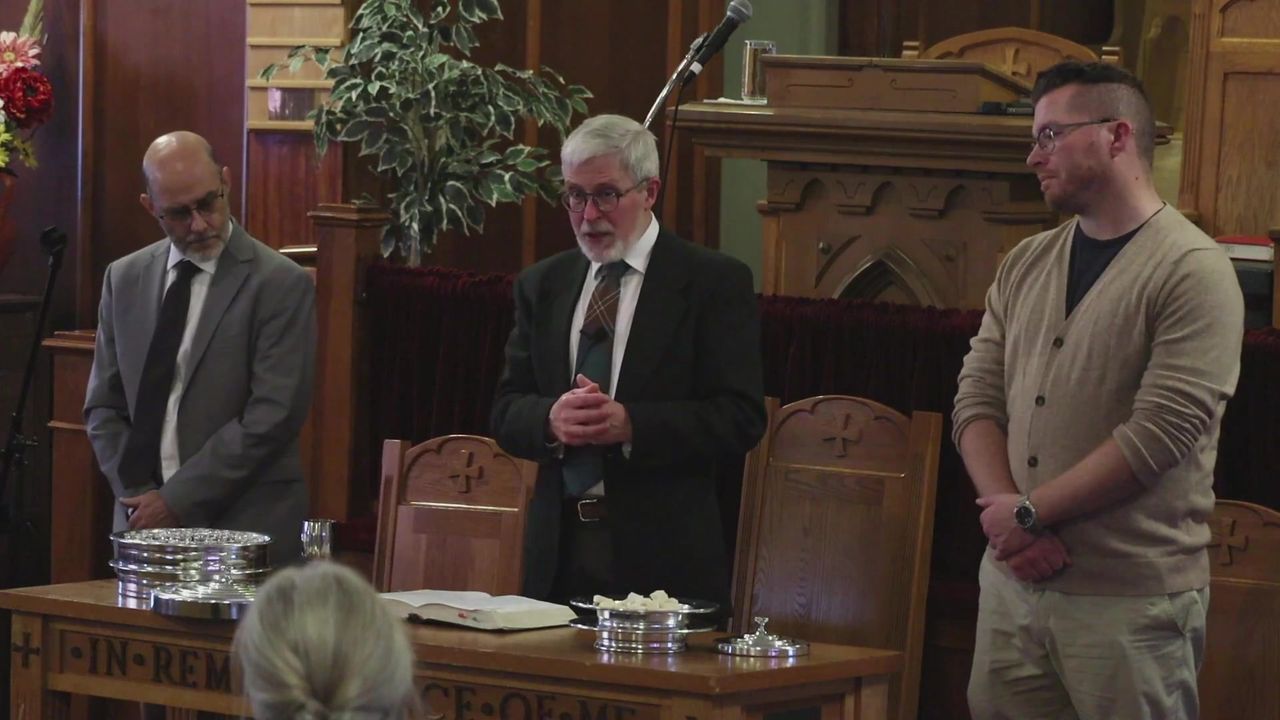
And then we say, what shall I render to the Lord for all his benefits to me? And that's our heart when we are filled with love how good the Lord is to us. At this table, we give thanks to the Father for giving us his Son to be our Redeemer for all of his benefits to us.
Been studying about the benefits in the catechism, haven't we? There's quite a few of them. We give thanks to the Son for being our Redeemer, for going to the cross for us. We give thanks to the Holy Spirit for uniting us to Christ our Redeemer and for renewing our sinful hearts.
And then being full of praise and thanksgiving to our God, we have a desire to pour out our lives for him, to do what we can in service to him and his church. We want to return his kindness to him in this way.
We therefore come to this table with an appetite for him to give us the ongoing nourishment, the ongoing growing delight in our King of glory and in his salvation and in his kingdom. That's one of the things that we want through communion with him, that this table testifies to us that he gives to us.
And the other thing that we want with that is we want then to be strengthened, to be able to go out and serve him in his kingdom, to love his people and to do good as he has called us to do, to warn them, to encourage them, to help them, to provide for them.
Whatever God has brought before us, to serve him with a whole heart and a delight in him. We have communion with Christ in order that we may bring forth the fruit of communion, of abiding in him. And this speaks of course to us about what he did to provide for us, that ultimate thing that he did that he sets before us and that he wants me as a minister to set before you that Jesus was crucified, that his body was broken and that his blood was shed and poured out for the remission of our sins.
And he told us that this bread and this cup represent him who was crucified for us and that eating it represents to us the communion that we have for him. It gives it to us in a tangible way that we look to him to bring those blessings to us that he has through that communion with him.
And we live in that blessing, we live in that nourishment of walking with Christ. It's not just a matter of doing a ceremony, it's a matter of communion with Christ that goes on through your whole life.
This is a token of it that we can see that he has given to us to encourage and strengthen our faith, to support our faith as we trust in him for that life that he gives to us. So hear now the words of institution for this sacrament from Mark's gospel.
And as they were eating, Jesus took bread and blessed and broke it and gave it to them and said, take, eat, this is my body. Then he took the cup and when he had given thanks, he gave it to them and they all drank from it.
And he said to them, this is my blood of the new covenant which is shed for many. Assuredly, I say to you, I will no longer drink of the fruit of the vine until that day when I drink it new in the kingdom of God.
And when they had sung a hymn, they went out to the Mount of Olives. Let me tell you who is allowed to eat at this table. You may eat at this table only if you have been baptized and are a community member in good standing of a faithful church.
You need to be one whose profession of faith and obedience has been heard and approved by the officers of the church that Jesus appointed for that purpose. He appointed them to do that. You need to be under the care of the church as a member in good standing.
And if you're not, then we would be glad to discuss that with you. So to all of you who are eligible to come, see that you come with thanksgiving to the Lord for saving your soul and for pouring out his soul on the cross for your sins.
And commit yourself to return thanks to him by faithful worship and service to him and his body. And look to do this by his nourishing grace, the nourishment of Jesus himself, who was crucified for us and who gave himself for us.
Let's ask him to bring these blessings to us as we come. Oh Lord, our God, we praise you and thank you that we can come to this table. And we pray, oh Lord, that you would be pleased to visit us here, that you would visit us with your mercy because you have shown us what you did for us on the cross, that you gave yourself on the cross to sacrifice.
Indeed, we're told in Isaiah that you poured out your soul and we praise you that it was not just your body, but also your spirit and your soul that you gave yourself wholly for us. And now, Lord, we come to you and we desire to have that spiritual fellowship with you, that bond of blessing that comes through your sacrifice.
And we pray, oh Lord, that you would be pleased to give us grace, that we may love you more, that we may love your kingdom more, that we may see who you are and what you have done, that we may walk with you in growing love.
And we pray that you would also give us grace, that we may then, in response to that, serve you, that we may give ourselves in service to your kingdom. For doing that is giving ourself in service to you.
We pray that we would do whatever your hand, or whatever you put in our hand to do, that we would always be ready to do what is pleasing in your sight, that we would not shun that, but we would delight in it, even if it is difficult or risky.
We thank you, Lord, for all of your goodness and mercies to us. Please, Lord, advance your kingdom. Let it spread all across our land and all around the world that you might be glorified. Your kingdom come, your will be done on earth as it is in heaven.
Our eyes are on you, Lord, for you are the king of glory, and you will reign until you bring all of your enemies under your feet. We praise you, we praise you in your great name, amen. So you may eat and drink as soon as a tray is passed to you, and then we'll give thanks for what we have received.
According to the holy institution, command and example of our Lord and Savior, Jesus Christ, I take this bread, and having blessed it, really, I already broke it, but I break it again, give this to you.
Take, eat, this is the body of Christ, which is given for you. Do this in remembrance of him. After Paul set forth the mercies of Christ in the first 11 chapters of Romans and told about all the beauty of his work, all the benefits that we have in it, he then said, I beseech you, therefore, brethren, by the mercies of God, that you present your bodies a living sacrifice, holy, acceptable to God, which is your reasonable service.
And do not be conformed to this world, but be transformed by the renewing of your mind, that you may prove what is that good and acceptable and perfect will of God. According to the institution, command and example of our Lord and Savior, Jesus Christ, I also take this cup and give it to you.
This cup is the new covenant in the blood of Jesus Christ, which was shed for the remission of the sins of many. Drink from it, all of you who are trusting in him.
To you, but give you opportunity to boast on our behalf,.
That you may have an answer for those who boast in appearance and not in heart. For if we are beside ourselves, it is for God. Or if we are of sound mind, it is for you. For the love of Christ compels us because we judge thus, that if one died for all, then all died.
And he died for all that those who live should live no longer for themselves, but for him who died for them and rose again. Therefore, from now on, we regard no one according to the flesh, even though we have known Christ according to the flesh, yet now we know him thus no longer.
Therefore, if anyone is in Christ, he is a new creation. Old things have passed away. Behold, all things have become new.
Thanksgiving, you're on this earth, Lord. Resting in you.
Let's sing Psalm 133 about the communion that we have with Christ, our King in our head, and our priest in this case, especially presented under the figure of Aaron. 133, 133a. Last words of the song that we sang was that God commands his blessing there.
And when God commanded and said, let there be light, there was light. He commands blessing, there's blessing. He knows how to bless his people. He's done it marvelously through all the centuries. So receive, as his people, the blessing of our God.
Now may our Lord Jesus Christ himself and our God and Father, who has loved us and given us everlasting consolation and good hope by grace, comfort your hearts and establish you in every good word and work.
Amen. Amen.